
Consolamentum: The Hidden Letters in the Apostles and the Message Leonardo Tried to Tell Us

What if the Last Supper has been speaking for 500 years, and we simply never learned the alphabet?
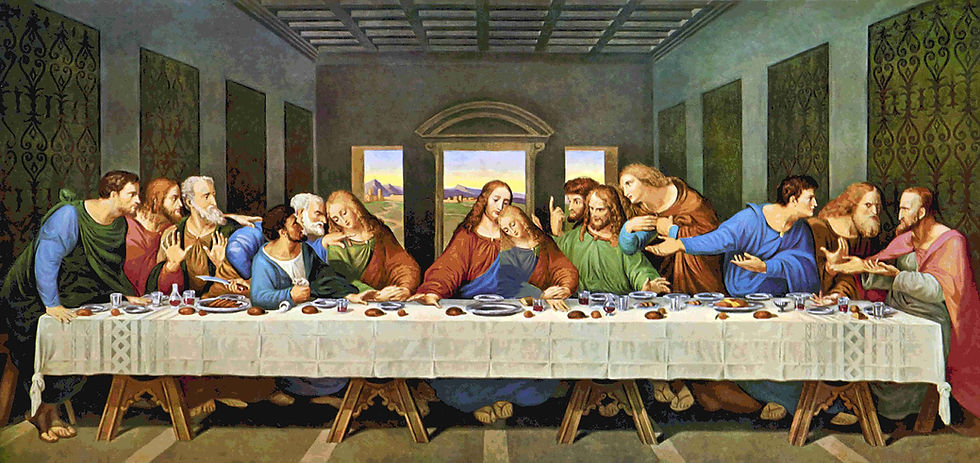
In Javier Sierra’s The Secret Supper, a startling idea emerges: Leonardo da Vinci encoded a message not in symbols, gestures, or geometry, but in something far quieter — the letters hidden within the apostles themselves. Each disciple is assigned a virtue-name, a title in Latin, and when the first letters are reordered and reversed, they reveal a single forbidden word:
CONSOLAMENTUM.

This was the Cathar’s most sacred rite, the “baptism of spirit,” the remembrance of divine origin, the moment one awakened to the truth that the divine spark within was the real source of salvation.
But in the novel — and perhaps in Leonardo’s own mind — the key to this word lies not in doctrine or dogma, but in people. In the men who surround Jesus. In the human beings who carry the message through the simple act of being named.
The Apostolic Alphabet
Each apostle is given a Latin quality in the novel — a virtue, a disposition, a signifier.And each of those titles begins with a letter.
A letter that matters.
Simon becomes Confector → C
Thaddeus becomes Occultator → O
Matthew becomes Navus → N
Philip becomes Sapiens → S
James becomes Oboediens → O
Thomas becomes Litator → L
John becomes Mysticus → M (but carries the hidden A)
Peter becomes Exosus → E
Judas Iscariot becomes Nefandus → N
Andrew becomes Temperator → T
James the Less becomes Venustus → V (reordered as U)
Bartholomew becomes Mirabilis → M
Reordered backwards — the way Leonardo often encoded his notebooks — the sequence reveals the forbidden word the Church sought to erase:

CONSOLAMENTUM.
It is not written on a scroll.
Not hidden in the bread.
Not found in a chalice (which Leonardo famously removed).
It is hidden in the people.
Those who journey with Jesus carry the message inside themselves.
Just like us.
Why Encode a Word in Men Instead of Objects?
Because the object can be taken.
The symbol can be banned.
The ritual can be outlawed.
But a name?

A name lives inside a person.
A name cannot be seized or burned.
A name cannot be erased from the mind.
By placing the sacred letters within the apostles, the novel implies a radical idea:
The Consolamentum was never a ritual. It was a recognition.
A remembering.
A realization that the divine spark — the Christ-light — is not transmitted through objects but through being.
The apostles do not point to the Consolamentum.
The apostles are Consolamentum.
And This Is Why Leonardo Removed the Chalice
In most Last Supper depictions, a chalice sits at the center: the mechanism of salvation, the vessel of divine grace.
Leonardo removed it.
Why?
Because the moment you remove the cup, the viewer is forced to look elsewhere.
Not at the table.
Not at the ritual.But at the people.
The sacred vessel was never silver or gold.
It was never an artifact or a relic.
The human being is the chalice.
The body is the temple.
The mind is the book.
The heart is the altar.
And the spark inside each person — the letter hidden in their name — is the Consolamentum itself.
The Thought That Changes Everything
If Leonardo used the apostles to encode a sacred truth, then the implication is staggering:
Every human carries a letter of the divine word.
Every life contributes to the hidden message.
Every soul is part of a larger revelation.
CONSOLAMENTUM is not a ceremony you receive.
It is the awakening you reclaim.
The memory of who you really are.
The recognition that salvation was never external — it was woven into your being from the start.

Just like the apostles, you are the letter in the great word.
The message the world forgot.
The treasure hidden in plain sight.
Bill
Comments