
Are We the Double-Slit Experiment?

There is a famous experiment in physics called the Double-slit experiment. It revealed something astonishing about the nature of reality: light and matter sometimes behave like particles, and sometimes like waves.

But what if this experiment is more than physics?
What if it is also a mirror of human life?
The Slit of Perception
Imagine life as a beam of light moving forward.
Each of us begins as a focused beam — moving through the narrow slit of identity. Our upbringing, beliefs, fears, and ambitions compress us into a tight path.
We move forward with direction and force.
School.
Career.
Responsibility.
Expectations.
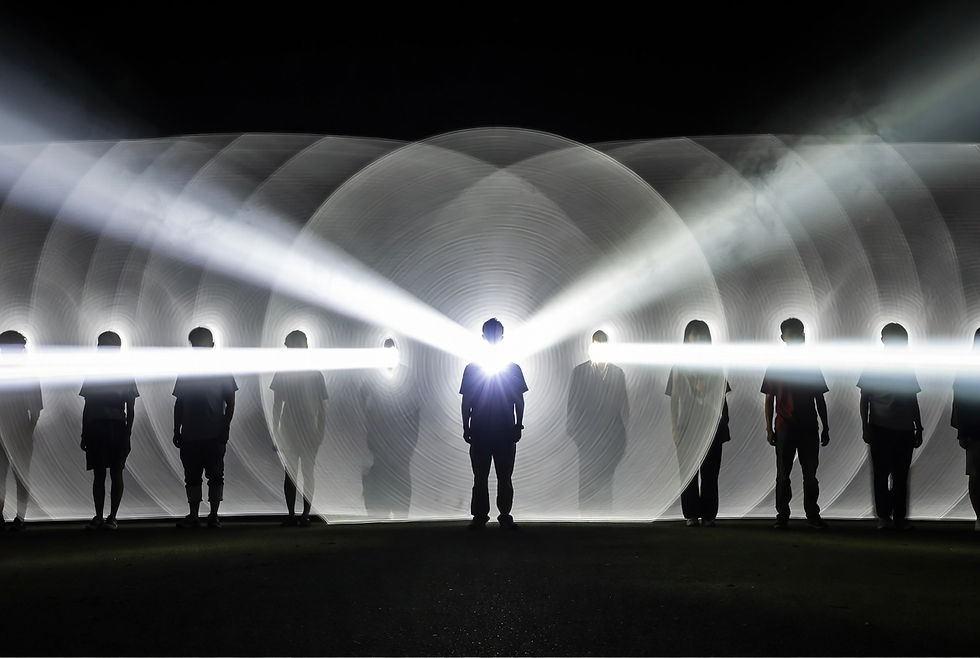
Like photons in the experiment, we pass through the slit and travel straight ahead — until we strike the back wall of reality.
Sometimes that wall is:
exhaustion
loss
questioning our purpose
or simply the realization that life must be more than survival
In physics, the back wall is the screen where the pattern appears. In life, it may be the moment where our deeper pattern begins to reveal itself.
The Moment No One Is Watching
The strange thing about the double-slit experiment is this:
when scientists measure which slit a particle goes through, it behaves like a particle.

But when no measurement is made, the particles behave like waves.
This idea fascinated many thinkers, including John Archibald Wheeler, who suggested the universe might be participatory — shaped by observation itself.
Now imagine this metaphorically applied to human life.
Most of our lives we are observed:
by society
by expectations
by our own internal critic
Under observation, we remain particles — separate, individual, defined.
But when observation quiets…
When the noise of the world fades…
When the mind enters stillness through meditation…
Something changes.
The Mind Becomes a Wave
In deep quiet, the boundaries of the self soften.
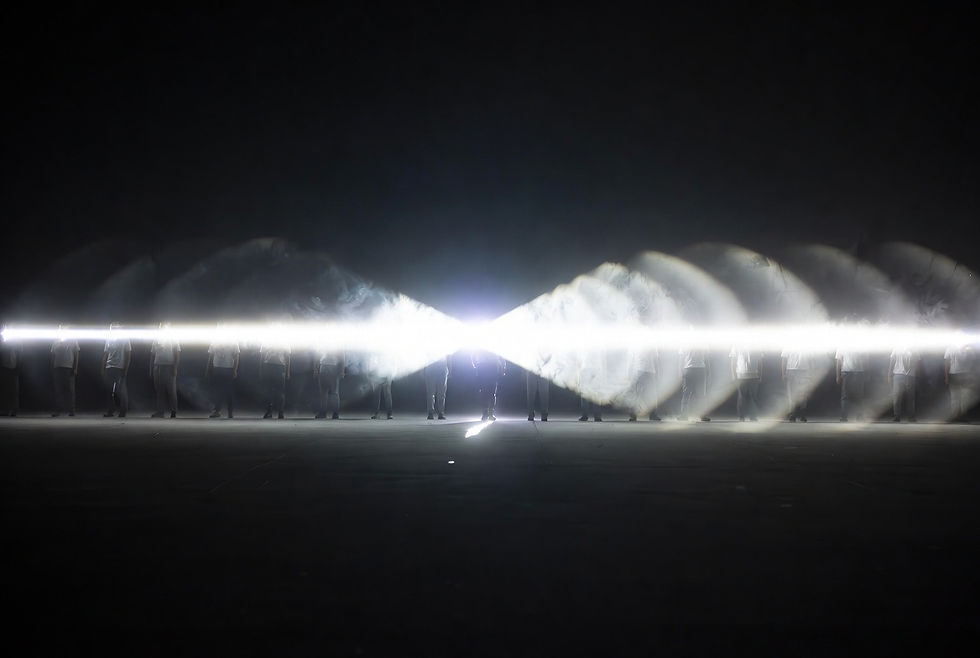
The narrow beam of identity spreads.
Thought slows.
Breath deepens.
Awareness expands.
In those moments we are no longer only particles moving alone through a slit.
We begin to behave more like waves.
And waves do something extraordinary.
They interfere with one another.
They cross.
They merge.
They amplify.
They create patterns that no single particle could ever produce.
Bentov’s Vision of the Human Wave
This idea resonates strongly with the work of Itzhak Bentov, author of the book Stalking the Wild Pendulum.

Bentov suggested that human consciousness behaves like a vibrating system.
According to his model:
the body oscillates
the heart creates rhythmic waves
the brain synchronizes with larger fields of vibration
Through meditation, Bentov believed our consciousness could move beyond the rigid structure of the body and resonate with larger universal patterns.
In other words, we stop acting like isolated particles and begin participating in a field of waves.
Interference and Oneness
In the double-slit experiment, when waves pass through two openings, they create a remarkable pattern on the screen — a series of bright and dark bands called an interference pattern.
No single particle creates this pattern alone.
It emerges only when waves overlap.
Now imagine humanity in the same way.
Each person is a beam passing through the slit of life.
Most of the time we travel forward alone, defined and separate.
But when enough minds become still…
When awareness expands…
When ego relaxes…
Our individual beams widen.
They cross.
They interfere.
They create patterns of cooperation, insight, creativity, and compassion.
Perhaps what we call higher consciousness is simply the moment when enough human beams begin behaving like waves.
The Wall Reveals the Pattern
The back wall in the experiment does not create the pattern.
It reveals it.
Likewise, the challenges and boundaries of life may not exist to stop us.
They may exist to show us the pattern we are part of.
And maybe that pattern only becomes visible when we stop forcing our way forward and allow the mind to soften into stillness.
The Possibility
If Bentov was right, and if consciousness truly behaves like a wave interacting with a larger field, then meditation may be doing something profound.
It may be allowing our beam of awareness to widen beyond the slit.
Not escaping the experiment…
But participating in it differently.
Less like a particle.
More like a wave.

And when enough waves begin to cross, something remarkable may appear on the screen of human history — a pattern that has always been there, waiting to be seen.
Perhaps what we call Oneness is simply the interference pattern of awakened minds.

I absolutely adore the idea of the double-slit experiment as a metaphor for human existence....it makes so much sense. Quantum physics is shifting the paradigm of thought.