
Is the Cave simply Blind Matter... Time to Turn Around???

What if leaving the cave is only the beginning?
I have been developing a diagram I call the Four Travellers—a personal reflection on ignorance, awakening, recognition, and freedom. As I explore ancient writings, I find precedents for the cave as a symbol of the world we inhabit.

The first Traveller lives inside a single loop: the cave. Its walls define what is possible. The shadows become truth because nothing else has been known.
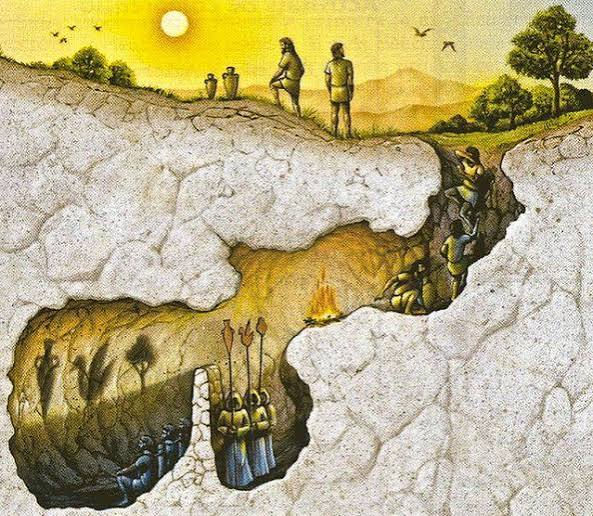
In Plato’s Allegory of the Cave, prisoners mistake shadows for reality. Plato identifies their prison with the visible world and the ascent from it with the soul’s movement toward understanding. The challenge is unsettling: how much of what we call truth comes from never having turned around? [classics.mit.edu]
The second Traveller discovers an opening and enters another loop. Awareness expands. Yet a question remains: have we become free, or simply entered a larger enclosure?
Porphyry’s On the Cave of the Nymphs gives this image another dimension. Interpreting Homer’s cave, he describes it as representing the world generated from matter. Its beauty reflects the forms that make existence attractive; its darkness reflects the obscurity of its material foundations. The cave can be captivating precisely because it is beautiful. tertullian.org

The third Traveller recognizes “as above, so below.” In my diagram, the planets correspond to centres within us, with Earth and the heart at the crossing. The solar system becomes a symbolic mirror of our inner experience.
There is an ancient precedent for linking the cave, the cosmos, and the soul’s journey. In his account of Mithraic mysteries, Porphyry describes cave sanctuaries as images of the cosmos, their contents representing cosmic elements and regions. He associates these rites with the soul’s descent into embodied existence and its departure. My planetary and chakra arrangement is my own interpretation, but the cave as a cosmic setting for the soul’s passage has ancient roots. [comingbacktolife.library.mcgill.ca]
But understanding a cycle does not necessarily release us from it.
The fourth Traveller is represented by the ankh. In my reading of its shape, the lower loop is no longer closed. It represents escape from the density and repetition I associate with material existence. The heart is the crossing—and the key.
Plotinus offers a related philosophical image. In Enneads IV.8.1, he interprets the caves of Plato and Empedocles as this universe, with release from chains and ascent symbolizing the soul’s journey toward the intelligible realm. The movement beyond the cave was already a subject of ancient spiritual inquiry. [www.ccel.org]
I also approach this question through the Bardo Thödol, the Books of Jeu, Pistis Sophia, and the Egyptian image of weighing the heart against the feather of Ma’at. These traditions deserve to be understood in their differences. Bringing them together is my exploration, rather than a claim that they teach one identical route.
A heart as light as a feather is a powerful image to sit with.

What makes mine heavy? Resentment? Fear? The need to control? Even the need to prove that my understanding is right?
Could spiritual knowledge itself become another loop if I turn it into an identity I cannot surrender?
The ancient writings give historical grounding to the cave as a symbol of sensory limitation, embodied existence, and the soul’s ascent. The Four Travellers is my way of exploring those themes—not a verified map of the afterlife.
Its most confronting question concerns how I live today:
If the heart is the key to freedom, what am I still asking mine to carry?


Comments