
Two Sons of the Father: The Collision of Two Jesuses

Cain and Abel. Romulus and Remus. Jesus Barabbas and Jesus Christ. And now, another collision involving two men named Jesus, with only one surviving. Is there a recurring message hidden within these stories, one that humanity has yet to fully recognize?
The Collision That Brought Me Back to the Two Jesuses
On November 2, 2026, news emerged of a tragic collision involving two men named Jesus, one of whom died while the other survived.

What first caught my attention was not simply the accident, but the names and the outcome.
Two men named Jesus. One collision. One survives. One dies.
I had already been exploring the possibility that the crucifixion narrative contains a deeper message about two identities, sacrifice and liberation. This contemporary event brought that question back into focus.
I do not suggest that a fatal accident was orchestrated to deliver a spiritual message. A human life was lost, and that deserves respect. But sometimes an event can draw our attention to a pattern already present in our thinking.
For me, this collision became an invitation to look more closely at an ancient story that many of us have heard throughout our lives without questioning its deeper structure.
Two Men Named Jesus Before Pontius Pilate
In certain ancient Greek manuscripts of Matthew 27:16–17, the prisoner traditionally known as Barabbas is identified as Jesus Barabbas.
The name Barabbas derives from the Aramaic bar abba, meaning Son of the Father.
This creates a remarkable scene.

Jesus Barabbas stands before Pilate alongside Jesus of Nazareth, who teaches of his relationship with the divine Father.
Two men named Jesus. Both associated with the Father. Both standing at a decisive point in their lives.
The crowd is offered a choice.
One Jesus is released.
The other Jesus is condemned to death.
The resemblance to the modern collision is not evidence that the two events are connected. But the shared structure is what interests me.
Two identities meet. Their paths collide. One continues living, while the other dies.
Could this recurring pattern be pointing toward something within the human experience?
Cain and Abel: The First Division
The pattern reaches back to Genesis.
Cain and Abel are brothers, both children of the same parents. Both bring offerings before God, but their offerings are received differently.
The resulting conflict ends with Cain killing Abel.
One brother survives. The other dies.
Cain subsequently builds a city named after his son Enoch.
Here we find a striking theme: the development of civilization follows a rupture between two closely related human beings.
I am interested not only in the physical death, but in the symbolic division.
Could Cain and Abel represent competing expressions of human consciousness?
One attached to possession, comparison and the material world; the other associated with offering and surrender?
This is an interpretive possibility rather than an explicit teaching of Genesis, but it provides a starting point for understanding the recurring pattern.
Romulus and Remus: The Foundation of Rome
Roman mythology presents another version of the divided pair.
Romulus and Remus are twin brothers, traditionally described as sons of Mars and Rhea Silvia.
Their disagreement over leadership and the founding of a city results in the death of Remus.
Romulus survives and becomes the legendary founder of Rome.
Again, two sons associated with a divine father. A conflict. One survivor. One death.
In Livy's account, Remus observes six vultures, while Romulus observes twelve.
The number six is particularly interesting within my exploration of the cube, the material world and the 666 code. However, the presence of this number does not establish a hidden relationship between Roman mythology and the Gospel narrative.
The larger connection is the structure of the story.
Cain survives and builds a city.
Romulus survives and founds Rome.
Barabbas survives while Jesus Christ is crucified.
But in the final story, something changes.
The one who dies becomes the central figure of a spiritual movement that ultimately transforms the Roman world.
Could that reversal be significant?
The Two Goats: Sacrifice and Release
There is an even older biblical connection.
In Leviticus 16, the Day of Atonement involves two goats.
One is sacrificed to God. The other symbolically carries the sins of the community into the wilderness.
One dies. One is released.
Biblical scholar Hans Moscicke has examined the possibility that Matthew's account of Jesus and Barabbas deliberately reflects this ancient ritual.
The parallel introduces an important distinction.
The two goats are not enemies in the ordinary sense. They serve different roles within a single process of purification.
Could the two Jesuses similarly represent two necessary aspects of transformation?
Perhaps the story is not simply about one individual being saved and another being condemned.
Perhaps it is about the relationship between what must be released and what must undergo death.
This brings us closer to my understanding of the human experience.
The Collision Within Ourselves
In my work on the three triangles and the 666 code, I have explored the idea that humanity exists within a material framework while possessing the potential for greater awareness.
I associate the number six with the human being operating within the material world, represented symbolically by the cube.
The cube provides structure, but it can also represent limitation.
We become attached to our possessions, beliefs, roles, fears and identities.
Over time, we may mistake these accumulated characteristics for who we truly are.
But what happens when the identity we have constructed collides with the identity we are beginning to discover?
Two expressions of the self cannot continue directing our lives in opposite directions indefinitely.
Something must change.
This is how I interpret the collision of the two Jesuses.
Not as a literal prediction of modern events, but as a symbolic representation of an inner confrontation.
The conditioned self encounters the awakening self.
One identity must surrender its authority so that another way of living can emerge.
The death, in this spiritual interpretation, is not physical. It is the relinquishing of a false identity.
And that distinction matters. Spiritual transformation does not require physical suffering or death.
Holy Week: The Four-Day Journey
During Holy Week in 2025, I undertook a 72-hour, four day fast that concluded on Easter Sunday, April 20, which was also my birthday.
The experience transformed my understanding of the Easter narrative.
I began to see the four days as a practical framework for inner transformation.
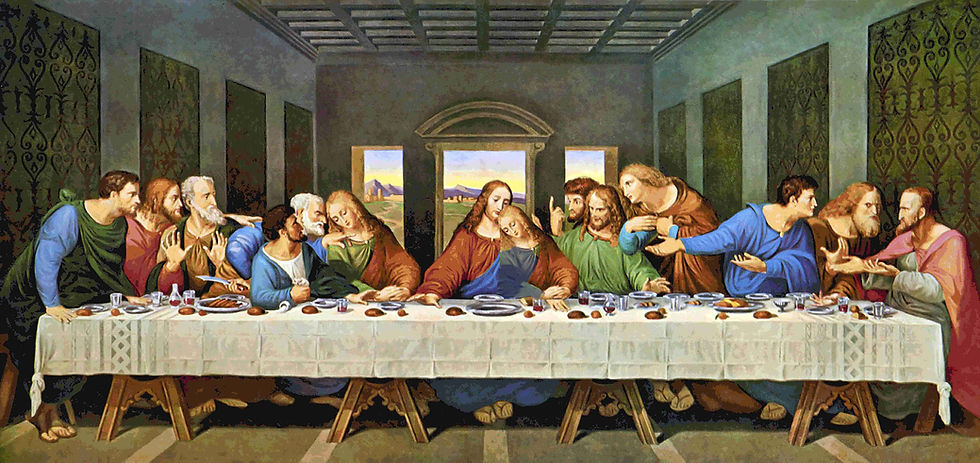
Thursday — The Last Supper
The conscious decision to step away from desire, consumption and the distractions of the material world.
Friday — The Crucifixion
The symbolic death of a false identity. The willingness to confront beliefs and attachments that no longer reflect our authentic nature.
Saturday — The Tomb
Stillness. Meditation. Surrender. The space between who we were and who we are becoming.
Sunday — The Resurrection
The emergence of a renewed identity, followed by the responsibility to live according to that awareness.
This interpretation is deeply personal. It is not a claim that the historical Last Supper was originally a fasting ceremony.
But the experience helped me recognize the relationship between fasting, meditation and the awakening of consciousness.
For me, the crucifixion represents a collision between the conditioned self and the possibility of authentic being.
And the resurrection represents what becomes possible when we no longer allow the old identity to govern our lives.
Two Sons, One Source
There is another important element.
If Jesus Barabbas means Jesus, Son of the Father, and Jesus Christ teaches of his relationship with the Father, then the narrative places two figures with closely related identities before the crowd.
What if this is a reflection of the human condition?
We are all born into the material world.
We all develop identities shaped by family, society, religion, education and experience.
Yet beneath those identities, I believe there is an authentic self connected to the source of creation.
The division occurs when we forget that connection.
The journey back is what I call Remembering.
42 is Remembering.
Within my interpretation of the 666 code, the path from material identity toward conscious awareness and liberation involves recognizing what we have become and rediscovering what we are.
The two Jesuses offer another symbolic expression of this process.
The collision is not necessarily between good and evil.
It may be between unconscious attachment and conscious awareness.
Between the identity we defend and the truth we are prepared to discover.
The Modern Collision and the Ancient Story
Returning to the November 2026 collision, I find myself asking why this particular event caught my attention.
There are countless accidents reported every day. This one stood out because of its unusual resemblance to a story I had already been examining.
Two men named Jesus.
One survives.
One dies.
The ancient Gospel narrative presents a similar contrast, but within a very different historical and theological setting.
The modern tragedy cannot establish that the Gospel contains a hidden code, nor can the Gospel explain why the accident occurred.
What the resemblance can do is encourage reflection.
It can lead us to investigate the manuscript evidence, reconsider familiar religious stories and ask whether their symbolic structures still have something to teach us.
That is where I believe the value lies.
Not in claiming certainty about an external sign, but in recognizing an opportunity for deeper understanding.
From Division to Authentic Creation
My three-triangle framework begins with the relationship between the Child, Mother and Father.
The second triangle explores Mind, Body and Soul, with meditation and fasting as practices that may help restore inner harmony.
The third triangle brings together Divine Masculine, Divine Feminine and Intervention: conscious action, intuitive receiving and the faith to allow the final piece to reveal itself in time.
I believe authentic creation becomes possible when these aspects of our being work together rather than in opposition.
The stories of Cain and Abel, Romulus and Remus, and Jesus Barabbas and Jesus Christ all provide opportunities to reflect on division.
But perhaps the purpose of recognizing division is ultimately to move beyond it.
Instead of allowing competing identities to remain in conflict, we can bring awareness to their origins and choose how we wish to live.
We do not need another person to die for our identity to change.
We do not need a physical collision to awaken.
We can begin through stillness, self-examination, fasting when appropriate, meditation and the conscious release of what no longer serves us.
The Choice Before Us
The Gospel account presents a crowd choosing between two men named Jesus.
The modern collision presents a tragic coincidence involving two people who shared that name.
The ancient stories of brothers and sacrifice reveal recurring themes of division, survival and transformation.
I do not believe these parallels should be dismissed without examination. Nor do I believe resemblance alone is proof of a hidden historical design.
For me, their significance is found in the question they inspire.
What happens when two versions of ourselves meet, and we can no longer continue living as both?
Perhaps the crucifixion can be understood not only as something that happened to Jesus, but also as an invitation to examine the identities we carry.
Perhaps resurrection begins when we stop defending what is false and start living what is authentic.
And perhaps the deepest meaning of the two sons of the Father is not that one must physically die for the other to live.
It is that an old way of being can end while life itself continues.
Two Jesuses. One Father. One choice.
The collision is within us.
42 is Remembering.
I AM.
33 is Liberation.
Historical Sources and Further Reading
Matthew 27:15–26 — Jesus and Barabbas before Pontius Pilate.
Genesis 4:1–17 — Cain, Abel and the founding of Enoch.
Leviticus 16 — The Day of Atonement and the two goats.
1 Enoch 6–11 — The Watchers and Azazel.
Stevan L. Davies, “Who Is Called Bar Abbas?” (1981).
Robert E. Moses, “Jesus Barabbas, a Nominal Messiah?” (2012).
Hans Moscicke, The New Day of Atonement (2020).
Author's note: The connections between ancient narratives, the contemporary collision, the three triangles and the 666 code are presented as a developing symbolic and spiritual theory. They are not established historical or causal relationships.
I have made the collision of the two modern Jesuses the opening and closing thread, rather than treating it as an unrelated coincidence. It now leads naturally into Barabbas, the two brothers, the two goats, your Holy Week fast and the three triangles.
One detail I would verify before publication is the precise reporting of the November collision, including the names, date and circumstances. That will keep the factual foundation as strong as the symbolic argument.


Comments